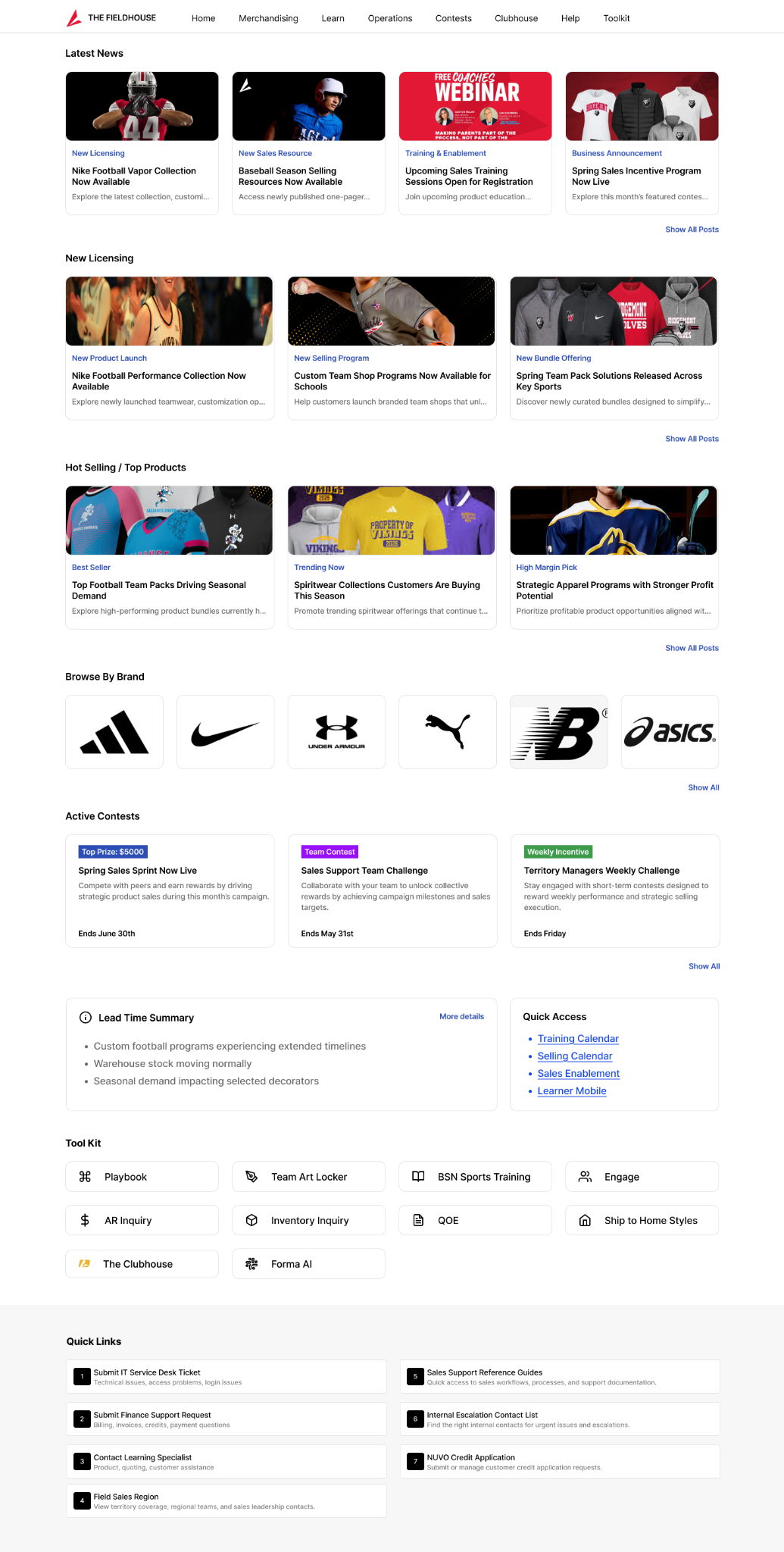
First release · zero schedule slip
Context
A one-stop shop was the starting request.
Varsity / BSN SPORTS had roughly 3,000 sales representatives working inside an approximately $2.5B business. Training, merchandising, operational resources, support, and internal tools were fragmented across destinations and communication channels. The initial brief was to bring them together. Staffbase had already been selected, so this was an enterprise product initiative with a real platform boundary, not an invitation to build unlimited custom software.
STAKEHOLDER INPUT / SALES-TEAM CONCEPT
The sales team made the breadth of the need visible.
Their concept grouped merchandising, training, operations, and selling resources alongside quick links. It gives concrete context to the “one-stop shop” request. My role was to investigate the work behind that request and shape a feasible product direction.
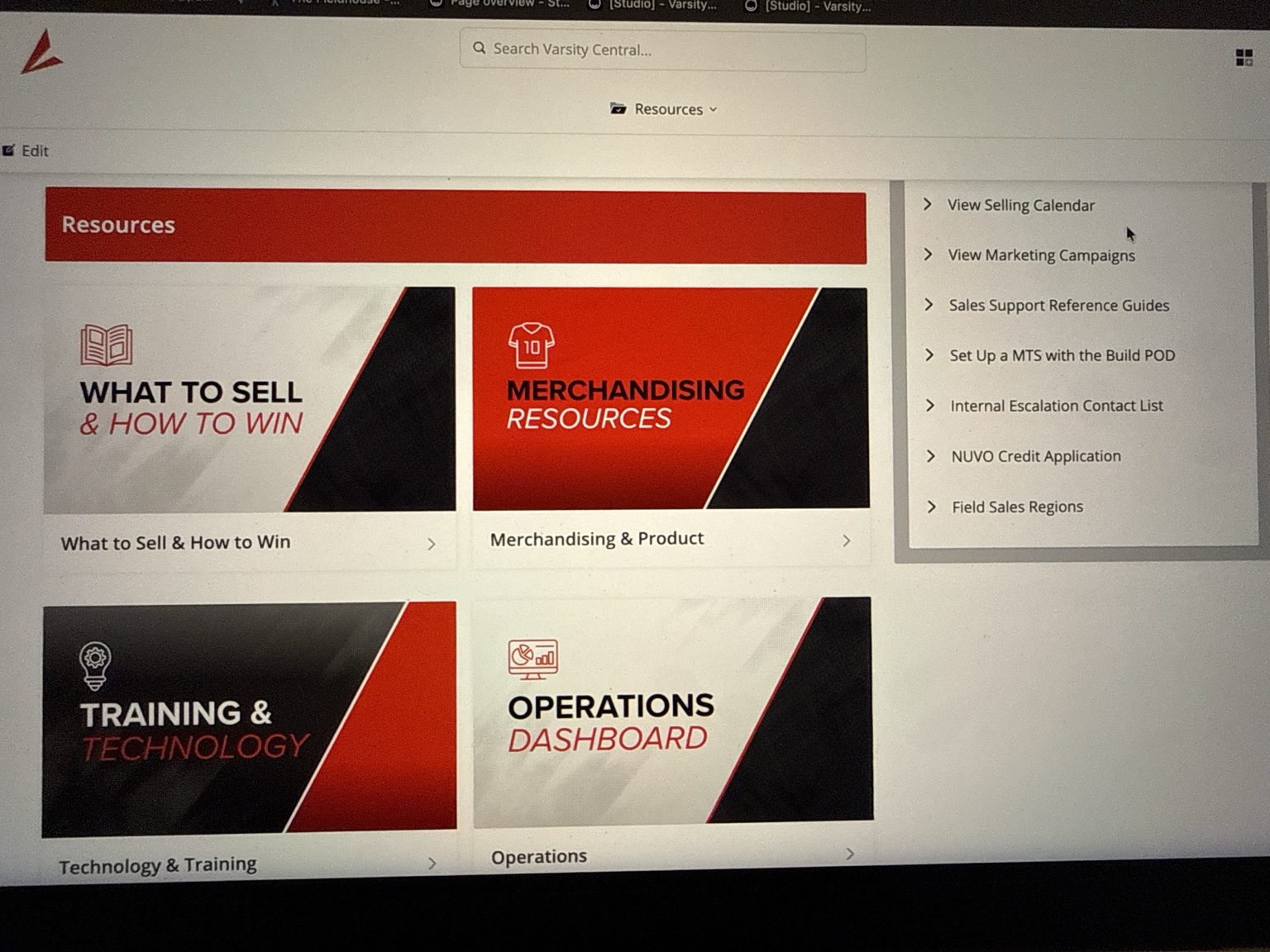
A stakeholder concept supplied by Mani. The red concept design belongs to the sales team; it is not presented as Mani’s design or as the final release.
View full imageMy ownership
I led the internal design team and external sales-team workshops.
I led the four-person internal design team and workshops with the external sales team to understand their workflows, needs, and constraints in depth. I owned the client-facing product workstream across discovery, customer research, problem framing, information architecture, prioritization, roadmapping, prototyping, alignment, validation, and delivery. Recurring client workshops involved roughly seven participants. I shaped the product direction and guided the team’s execution; the client and implementation team retained their own business and delivery responsibilities.
Evidence
I interviewed 20+ sales representatives.
The evidence moved the diagnosis beyond finding links. Reps were navigating fragmented systems and resources while trying to do their jobs. Centralizing access could help, but the research exposed a broader sales-enablement opportunity. The important distinction was between organizing destinations and understanding the work those destinations were meant to support. That distinction changed the scale of the product conversation without removing the delivery constraints.
IN THE RESEARCH SETTING
Bring the rep’s working context into the conversation.
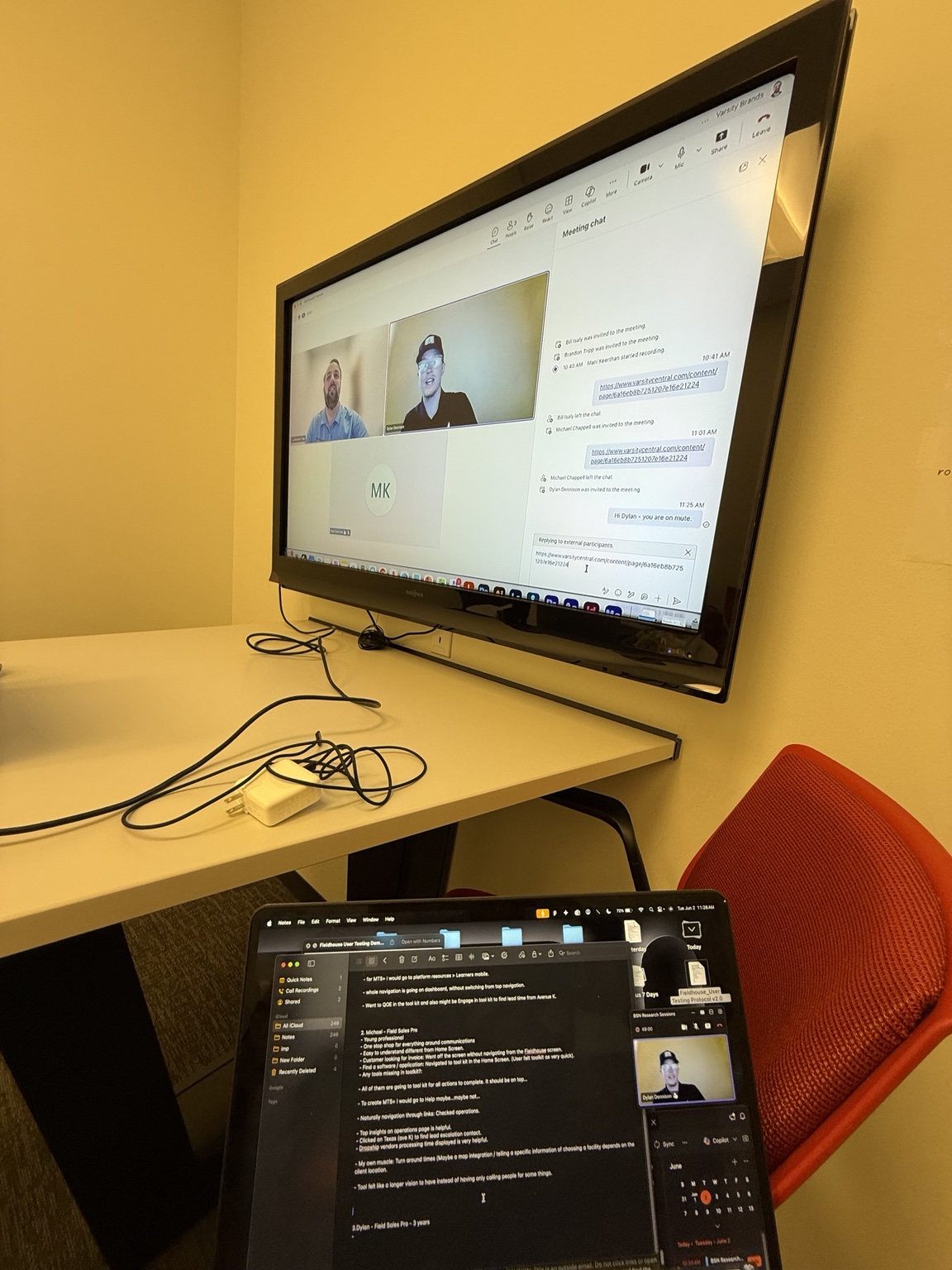
A view of the research setting, with a call and notes visible. The photograph accompanies the discovery account; specific quotations and synthesized findings still need their source records.
View full imageProduct judgment
Define a larger vision. Sequence the commitment.
The central decision was whether to treat Fieldhouse as a centralized portal or as the first expression of a sales-enablement platform. I helped reframe the initiative toward the latter, then organized opportunities into Horizon 1, Horizon 2, and Horizon 3. The roadmap connected an immediate release to a larger opportunity. It did not turn every research finding into a requirement for the first launch.
| Horizon | Commitment | Product logic |
|---|---|---|
| H1 | Useful first release in Staffbase | Current needs within ~2 months |
| H2 | Deferred opportunities | Extend the sales-enablement direction |
| H3 | Longer-term ambition | Preserve the vision without overloading launch |
Decision summary reconstructed from Mani’s account. Original artifact not supplied.
Trade-off
Future capability gave way to a useful first release.
We chose a valuable Horizon 1 within Staffbase and an approximately two-month deadline at the expense of delivering the ideal future product immediately. More ambitious capabilities were deferred. This was a prioritization decision about what the organization could use now, what the platform could support, and what could be implemented on time. The exact feature-by-feature horizon allocation needs further source context before it can be presented as evidence.
Influence & execution
Keep the broader opportunity connected to delivery.
Research, prototypes, the Horizon roadmap, workshops, and client reviews supported the alignment process. I led the internal design team through discovery, validation, implementation constraints, reviews, and launch. Workshops with the external sales team helped deepen our understanding of their day-to-day work and connect that context to product priorities. The roadmap made it possible to discuss the larger opportunity while continuing to deliver the first release. The precise points of stakeholder disagreement have not been documented here; I do not present a fabricated conflict or a single conversation as the cause of alignment.
PLATFORM REALITY
A product within an existing enterprise environment.
The supplied capture places Fieldhouse inside Varsity Central, with its own navigation beneath the surrounding enterprise navigation. That context makes the platform constraint tangible: the experience had to work within the environment already chosen.
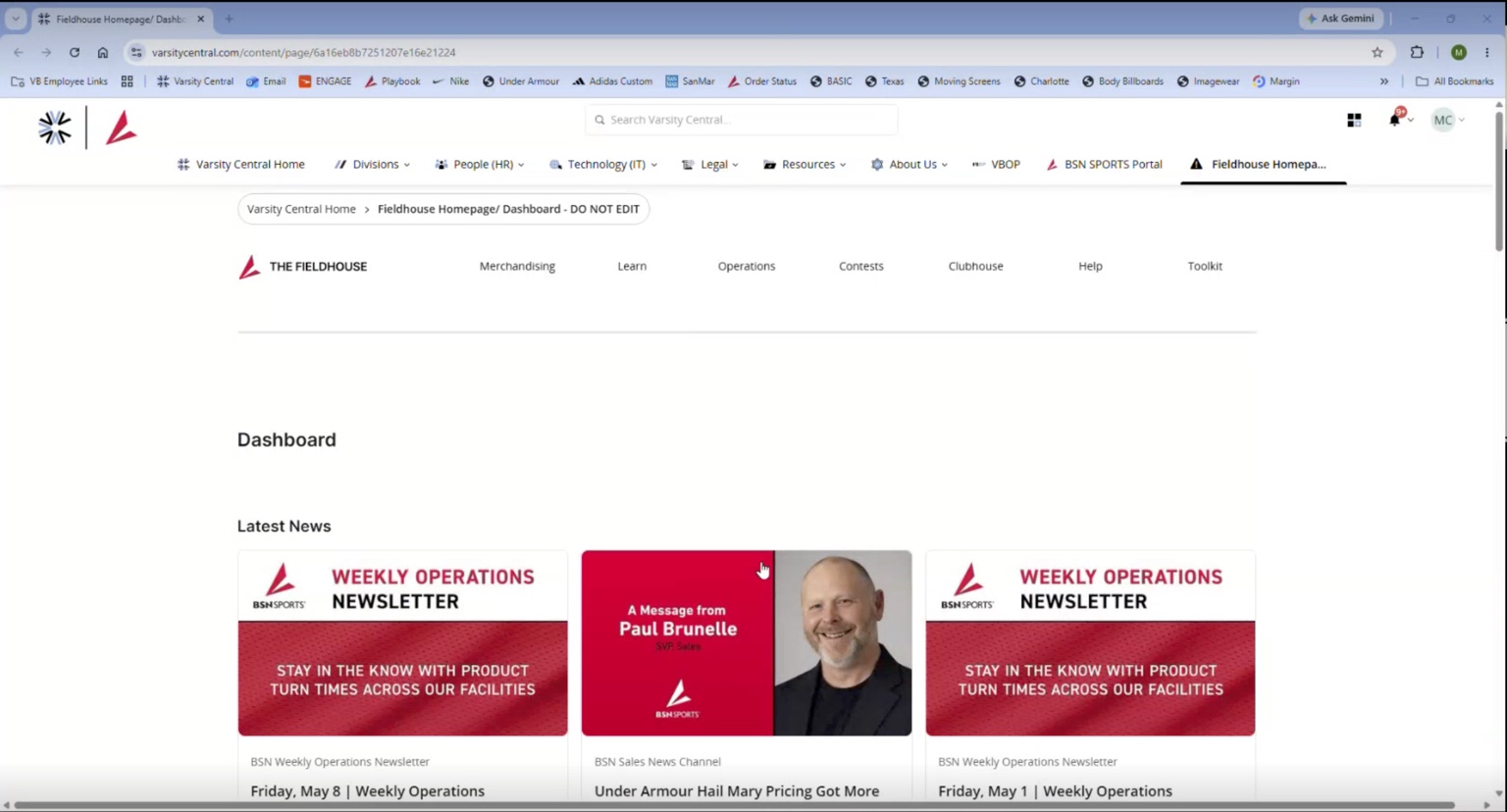
Fieldhouse shown in the enterprise environment. The capture’s release stage is not established; it illustrates implementation context rather than adoption or launch acceptance.
View full imageOutcome
The first product shipped without schedule slip.
Fieldhouse shipped in approximately two months for the roughly 3,000-rep network. Research and the Horizon roadmap helped surface follow-on opportunities, contributing to two follow-on projects. My product work strengthened client trust and helped expand the relationship; commercial teams owned the deals. The size of the sales organization is deployment context, not evidence that every rep adopted the product. A verified post-launch adoption result is not yet available.
Learning
A bigger diagnosis does not require a bigger first release.
This case connects discovery to enterprise execution: understand the broader job, establish a direction, and make a deliberate first commitment. The strongest evidence is the reframing, sequencing, and on-time delivery. The next question is whether the shipped experience improved the work of sales representatives—not simply whether a central destination existed.
THE REASONING BEHIND THE RESULT
What made the decision difficult?
Inspect ownership, evidence, alternatives, technical constraints, and the limits of the result.
CONTINUE THROUGH THE WORK