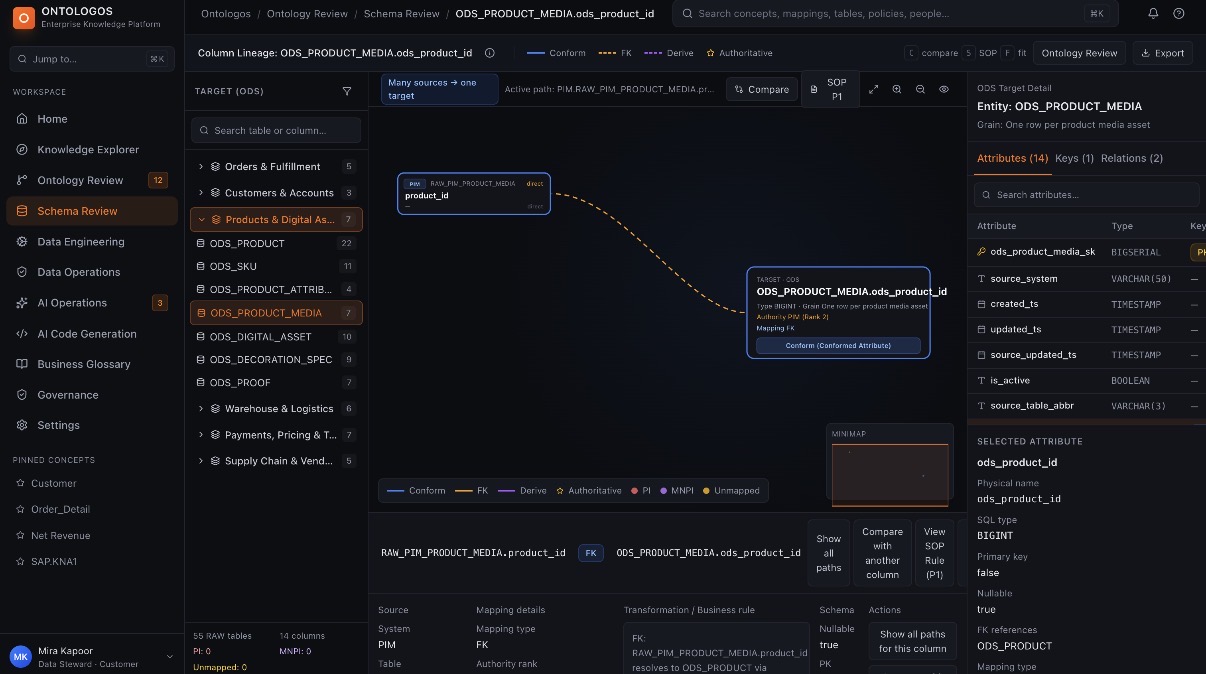
Toward a client-backed product direction
Context
A year of technical thinking needed a product expression.
Ontologos had existed as an internal enterprise AI/data-platform concept for roughly a year. The team had substantial technical thinking, but product clarity, usability, differentiation, and customer readiness remained difficult. The challenge was not simply to give the concept a cleaner interface. It was to make the workflows concrete enough that stakeholders could understand the value, engineers could identify requirements, and a customer could evaluate the emerging product.
My ownership
I took initiative around the product layer.
I spent approximately the first two weeks learning the domain, interviewing stakeholders, understanding workflows, researching enterprise-data concepts, and clarifying use cases. Over the next two weeks, I built a functional integrated experience, iterated workflows, collaborated with backend and data engineers, integrated available APIs, and validated the evolving product. I defined what the user and product layer required. I did not architect the backend.
Evidence
Working flows exposed questions abstract discussions could not settle.
The workflow spans discovery, profiling, remediation, schema mapping, ETL, reconciliation, and governance. We designed around approximately 12 domains, up to 20 entities per domain, and up to 66 attributes per entity. Differently named fields—such as CRM customer_id, SAP business_partner_no, and store user_id—can represent the same Customer concept. Making those relationships visible required clear metadata, provenance, and source-to-target behavior.
Product judgment
Build enough to remove uncertainty.
The central decision was to make enough of the product work to support better decisions, rather than continue debating the concept only in the abstract. The prototype served as a shared product definition. It helped clarify metadata requirements, workflow behavior, API needs, and how complex enterprise concepts should appear to users. Its value was the decision cycle it enabled, not the amount of code or the polish of individual screens.
| Interval | Focus | Decision enabled |
|---|---|---|
| Weeks 1–2 | Domain learning and stakeholder interviews | Clarify use cases and workflows |
| Weeks 3–4 | Functional experience and API integration | Inspect data, behavior, and technical gaps |
| Next validation | Real enterprise data with v1.0 partner | Evaluate the product direction |
Decision summary reconstructed from Mani’s account. Original artifact not supplied.
PRESENTATION PROTOTYPE / WANDER
Make the relationships visible.
Ontologos is the product. Wander is the name I used for this AI-assisted presentation prototype. The screen expresses an ontology through connected entities, attributes, and a contextual inspector—making complex concepts easier to examine in a product conversation.
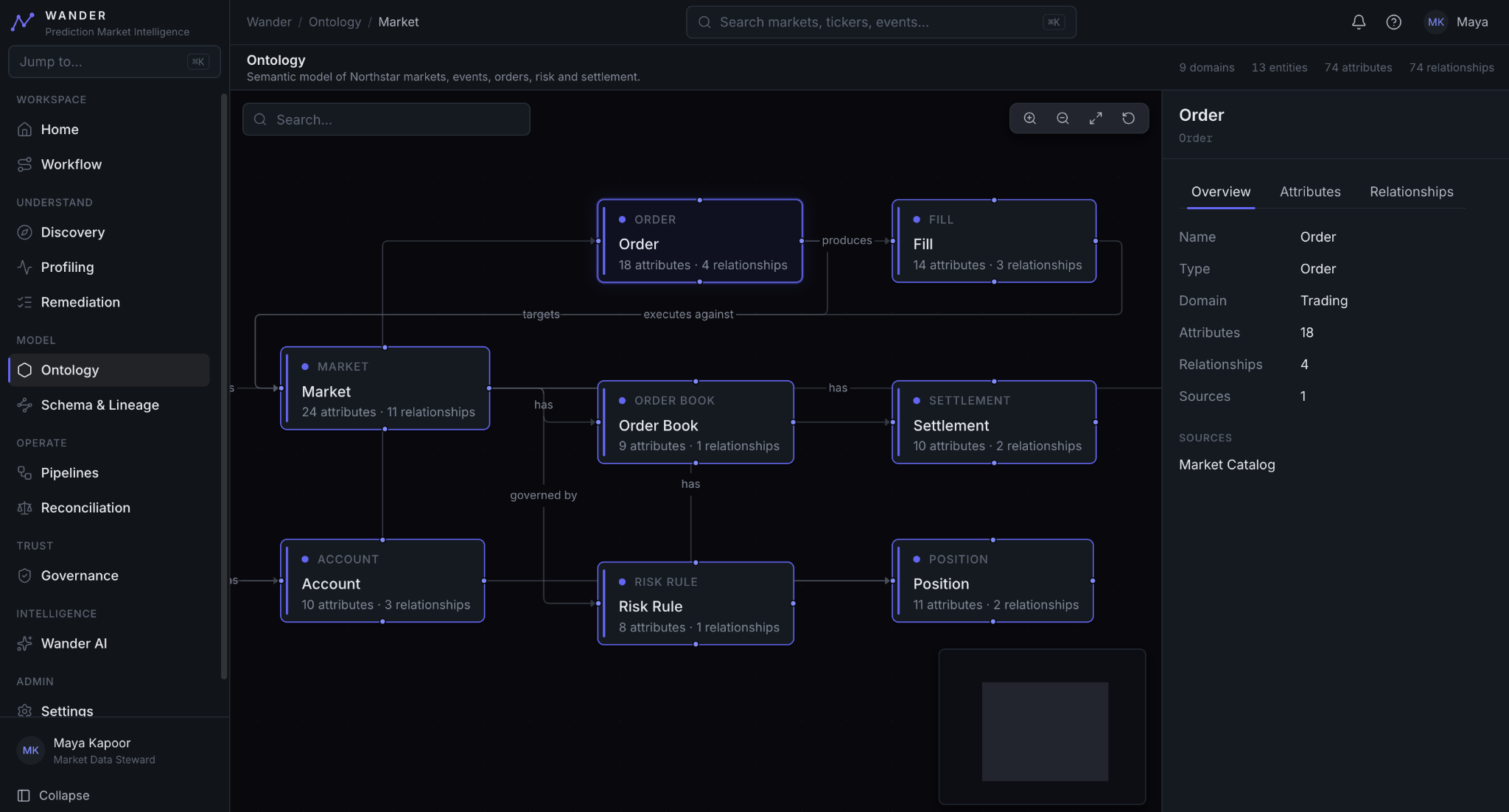
The prototype’s Wander branding is preserved. Its market scenario illustrates the presentation; it does not redefine Ontologos’s customer or establish a production deployment.
View full prototype screenTrade-off
Choose a concrete learning surface over abstract completeness.
The approach prioritized an integrated experience built with available APIs and engineering collaboration. It did not imply every underlying technical question had been solved. Cursor, ChatGPT, Lovable, and AI-assisted development accelerated execution, but they were means rather than the product thesis. Detailed scope exclusions and production-hardening trade-offs need more context. I do not equate a functional prototype with a fully validated enterprise platform.
Influence & execution
Give internal and customer conversations a shared object.
The working product made the direction concrete enough to align internal stakeholders, present to senior and C-suite leaders, and move toward customer validation. Backend and data engineers remained essential partners. Rather than describing an interface handoff, the execution story is a feedback loop between workflows, available data, API behavior, and stakeholder review. The product layer made requirements easier to examine and discuss.
Outcome
The concept moved toward a client-backed SaaS direction.
In approximately four weeks, I helped convert a long-running internal concept into a client-backed product direction. Varsity Brands became the v1.0 client / partner using real enterprise data. That is a shared business outcome to which my work contributed. I do not claim to have closed the customer, independently created the commercial relationship, or designed the underlying data architecture.
Learning
A prototype can be a product-management instrument.
The important shift was from discussing what the product might be to evaluating how it actually behaved. Design and technical prototyping gave me an execution advantage: I could make ambiguity visible and help the team act on it. Customer readiness still requires evidence beyond internal conviction. The specific feedback that created v1.0 confidence is the next part of this story to substantiate.
THE REASONING BEHIND THE RESULT
What made the decision difficult?
Inspect ownership, evidence, alternatives, technical constraints, and the limits of the result.
CONTINUE THROUGH THE WORK