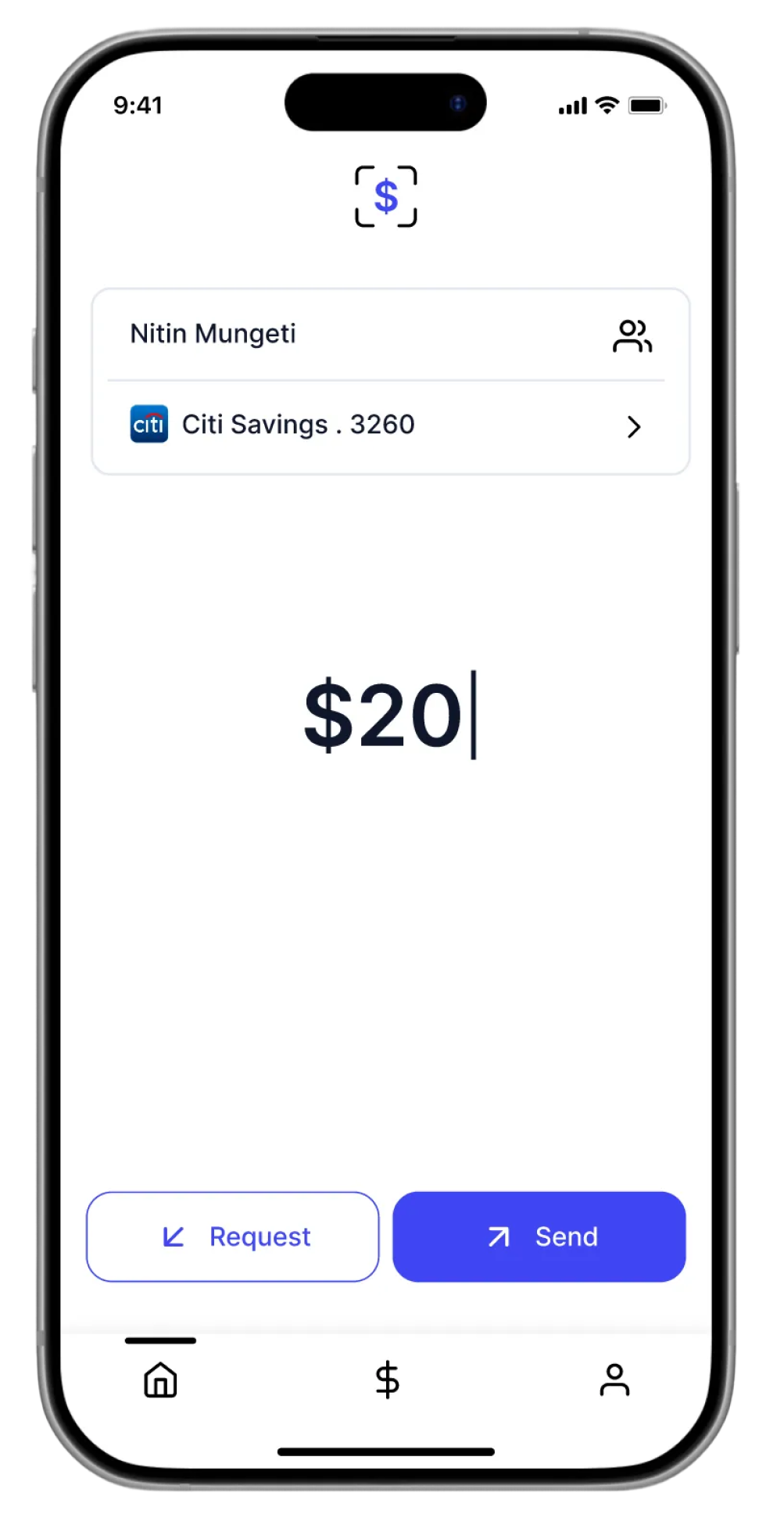
Testing participants understood “instant, no-fee”
Context
“Pay anyone from any app” was compelling but unproven.
The student venture started with an idea close to universal cross-app payments. Its appeal was easy to understand. Its technical and economic feasibility was not. I served as Product Advisor – Payments to a student venture in the Diamond Challenge entrepreneurship program. Before investing in interface polish, I questioned whether the proposition could actually operate as imagined. That was the central product risk to address first.
My ownership
I brought feasibility and economics into the product conversation.
I researched payment products and infrastructure, including Zelle, Cash App, Apple Pay, Stripe, ACH, RTP, FedNow, Request for Payment, P2P economics, merchant payments, monetization, acquisition, and payment workflows. The purpose was to understand which product promises were credible and which business model could support them. I advised the team’s direction; I do not claim ownership of a production payment network or a regulated operating business.
Evidence
The original concept did not hold up as imagined.
Technical and economic investigation showed that the cross-app idea was not realistically feasible in its original form. This changed the product question from how to package the concept to what viable payment proposition the team could pursue. The supplied research boards now document cost and pricing scenarios, but not verified provider terms or the precise integration blockers, so the narrative does not claim that a specific rail guarantees universal interoperability or a fixed transaction price.
Product judgment
Reframe around unified P2P and merchant payments.
The direction shifted toward unified person-to-person and merchant payments. Merchant payments were explored as a possible monetization engine, with business willingness to pay potentially enabling low-cost consumer payments and supporting acquisition economics. The business hypothesis included $3.50 for unlimited consumer payments, supported by merchant-led monetization and GTM. The original board preserves an earlier $2.99 pricing exploration. It was a business-model hypothesis, not evidence of customers paying that amount or a proven sustainable subscription.
| Dimension | Initial idea | Explored direction |
|---|---|---|
| Promise | Pay anyone from any app | Unified P2P + merchant payments |
| Product question | How should it look? | Can it work technically and economically? |
| Economics | Unclear | Merchant monetization hypothesis |
| Evidence boundary | Compelling concept | Modeled economics and reported user testing |
Decision summary reconstructed from Mani’s account. Original artifact not supplied.
UNIT ECONOMICS / A READABLE RECONSTRUCTION
One transaction.
Three economic questions.
The supplied slide models a $100 merchant payment at 1.8% + $0.15. The view below makes its arithmetic explicit. It is a reconstruction of a research scenario, not a claim about current fees or actual payment performance.
Illustrative payment
$100 − $1.95 modeled fee
1.8% × $100 + $0.15
The cost assumption changes the remainder.
$0.41 total cost
$1.95 − $0.41 = $1.54
$0.41 processing + $0.01 rail
$1.95 − $0.42 = $1.53
The original labels total cost as $0.41 but separately lists ~$0.01 and ~$0.41 components. Its $1.53 remainder matches the second interpretation. This is before any additional unmodeled costs, not verified net profit.
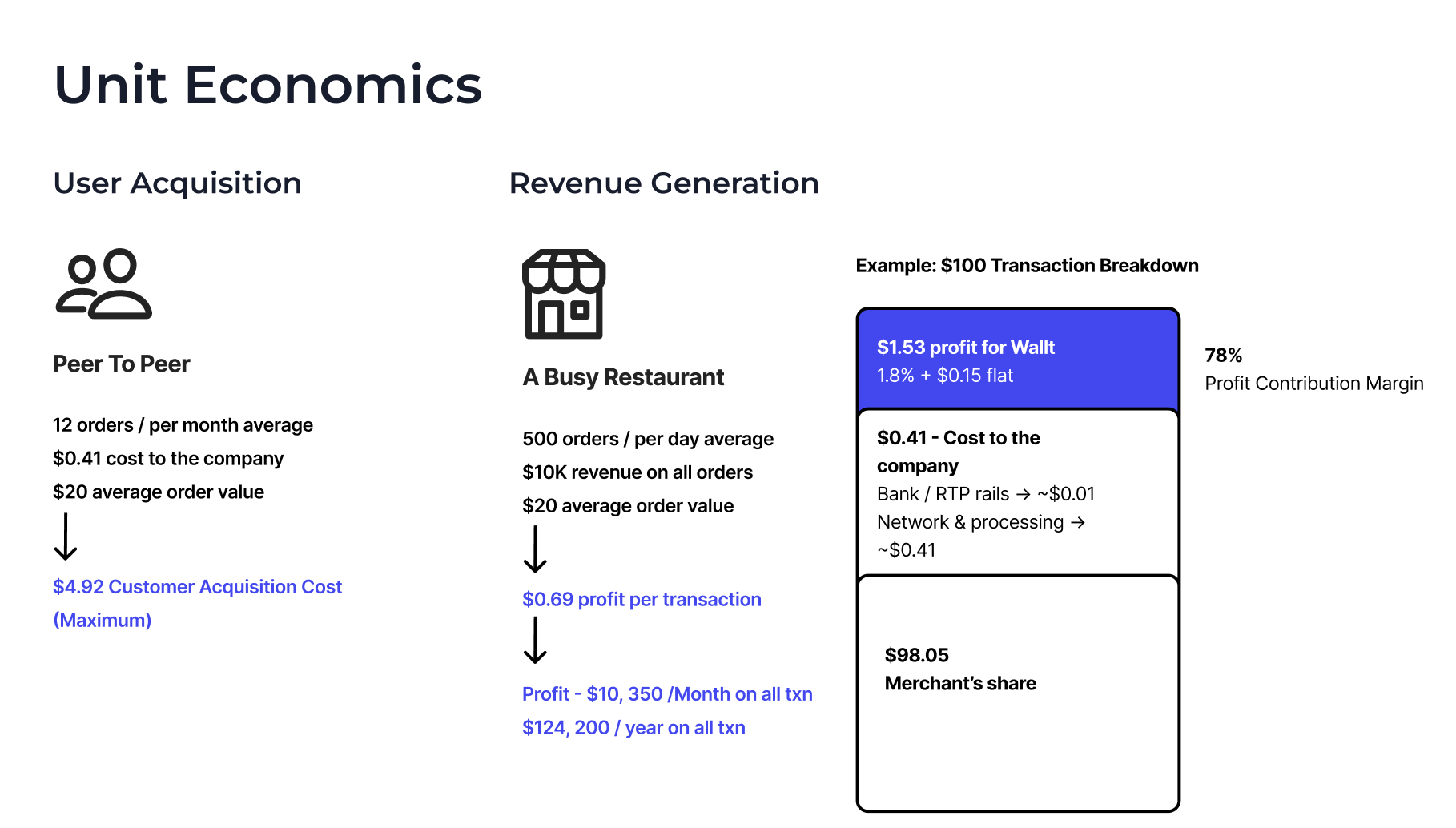
Original unit-economics slide, preserved as evidence of the modeling work. The 78% margin and restaurant profits are projections. The $20 restaurant scenario and $0.69 per-transaction figure require separate reconciliation; they are not derived here from the $100 scenario.
Open originalTrade-off
Give up the universal promise to examine a more feasible business.
The original promise was broader and easier to pitch than the narrower feasibility work it required. The pivot favored a proposition grounded in payment and economic constraints over preserving the original story unchanged. RTP / FedNow and Request for Payment were explored with modeled merchant transaction costs targeted below roughly $0.10. That figure was a modeled target, not a live transaction result or a guaranteed rail cost.
Influence & execution
Make feasibility part of the product before polishing it.
Advisory work connected competitive research, technical investigation, economics, monetization, acquisition, and user validation. The proposed onboarding was brought to under ten seconds, and roughly 90% of testing participants understood the “instant, no-fee” proposition. The sample and measurement setup still need detail. These signals concern the proposed experience; they do not validate the entire payment infrastructure or commercial model.
Outcome
The premise changed, and the proposition became more testable.
The team moved away from the original cross-app concept toward unified P2P and merchant payments. The strongest supported validation is the reported understanding of the value proposition in testing. The exact Diamond Challenge placement is not published because its official designation has not been verified. No live payments, production unit economics, or merchant revenue are claimed.
Learning
A product promise is also a technical and economic commitment.
The useful intervention was to question feasibility before treating the original idea as a fixed requirement. Payment rails, willingness to pay, and acquisition economics affected the product direction. The next evidence needed is a substantiated cost model and a credible operating path, alongside clearer test methodology. Interface clarity is valuable, but it cannot establish that the business works.
THE REASONING BEHIND THE RESULT
What made the decision difficult?
Inspect ownership, evidence, alternatives, technical constraints, and the limits of the result.
CONTINUE THROUGH THE WORK