Development grant the work contributed to
Context
There was no mature product to inherit.
Future X began in the Emerging Technology Lab around spatial, AR, and VR creation workflows. The original problem framing identified a gap between creating interfaces in 2D tools and rebuilding or evaluating them in Unity and VR. The work required finding a product opportunity, not improving an established funnel. The initial business thesis was more consumer-oriented. The opportunity had to be understood through domain, market, and practitioner research before a credible MVP or business direction could be defined.
My ownership
I took product-lead-like responsibility in a research role.
My formal role was Research Assistant. In practice, I carried substantial product-direction responsibility across a roughly four-person team. I helped define personas, the USP, product opportunities, MVP scope, PRDs, concept drawings, prototypes, roadmap priorities, and business-model thinking. That ownership sat inside a research organization with faculty leadership; I do not present it as sole authority over every funding, patent, or institutional decision.
Evidence
Practitioner research changed the business direction.
Discovery covered domain, market, and practitioner research, including people associated with Microsoft, Meta, and HTC. Their involvement is research context, not a claim that those companies bought or endorsed the product. The evidence suggested a stronger opportunity through B2B / B2B2C SaaS than the initial consumer-oriented thesis. The precise interview findings and segment comparisons need source artifacts before they can be shown as detailed proof.
Product judgment
Reconsider who the product should serve.
The central decision was to move the business thesis from a more B2C-oriented concept toward B2B / B2B2C SaaS. That changed the product question from a general consumer proposition to an opportunity better grounded in organizational or practitioner contexts. Product discovery informed the USP, MVP, requirements, and roadmap. The available account does not identify the exact first buyer, pricing model, or distribution route.
| Signal | What it supported | What it did not prove |
|---|---|---|
| Practitioner research | Opportunity and product direction | Broad category adoption |
| Provisional patent filing | Formal filing progress | Granted patent or PMF |
| ~$40K grant | Development funding | Customer demand |
| Insufficient adoption | Market-readiness limit | A viable ongoing product |
Decision summary reconstructed from Mani’s account. Original artifact not supplied.
MAKE THE PRODUCT DIRECTION TANGIBLE
One interface.
More than one way to evaluate it.
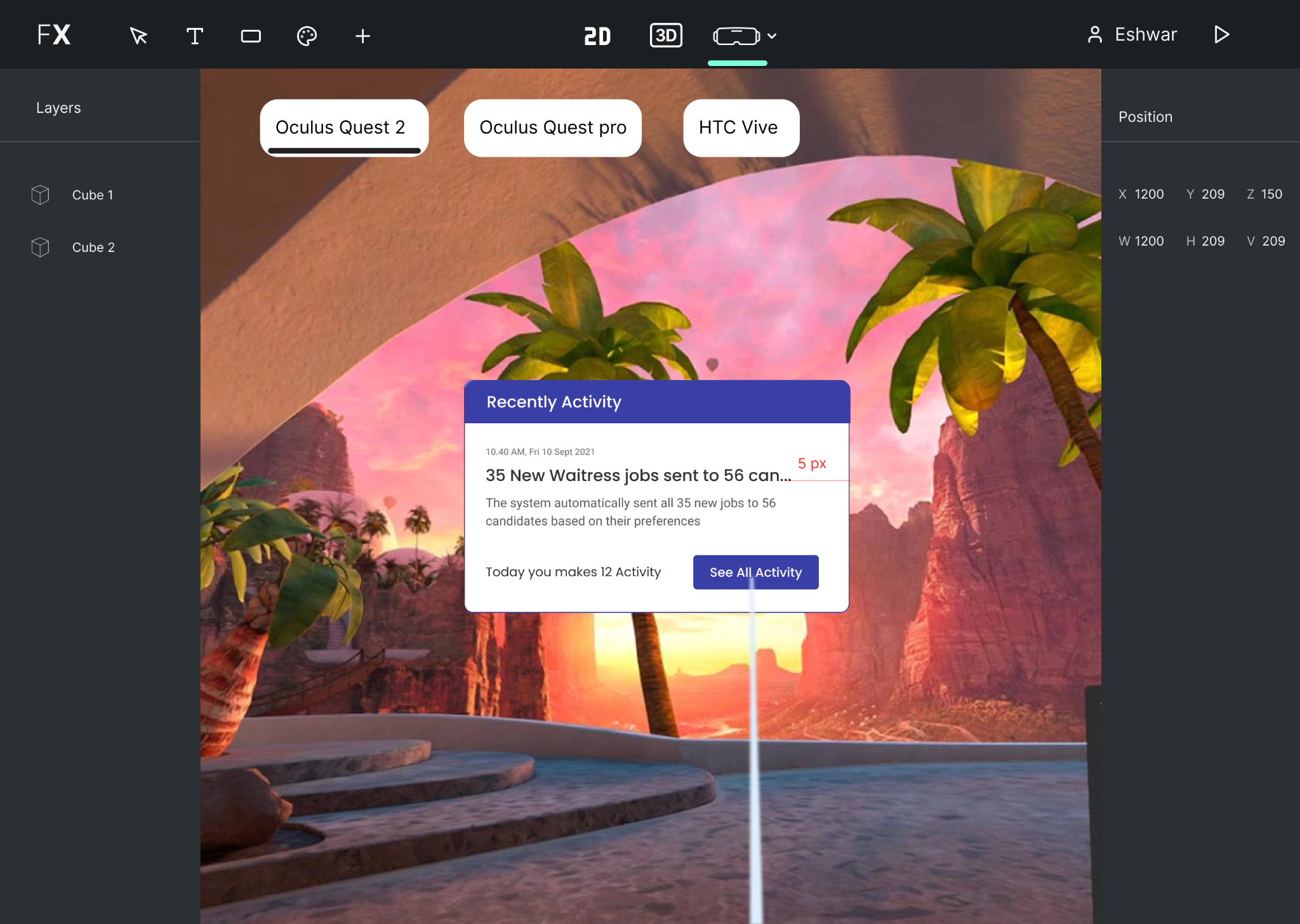
The supplied screens show how the product idea moved from a canvas to spatial placement and headset preview. Explore the original views below.
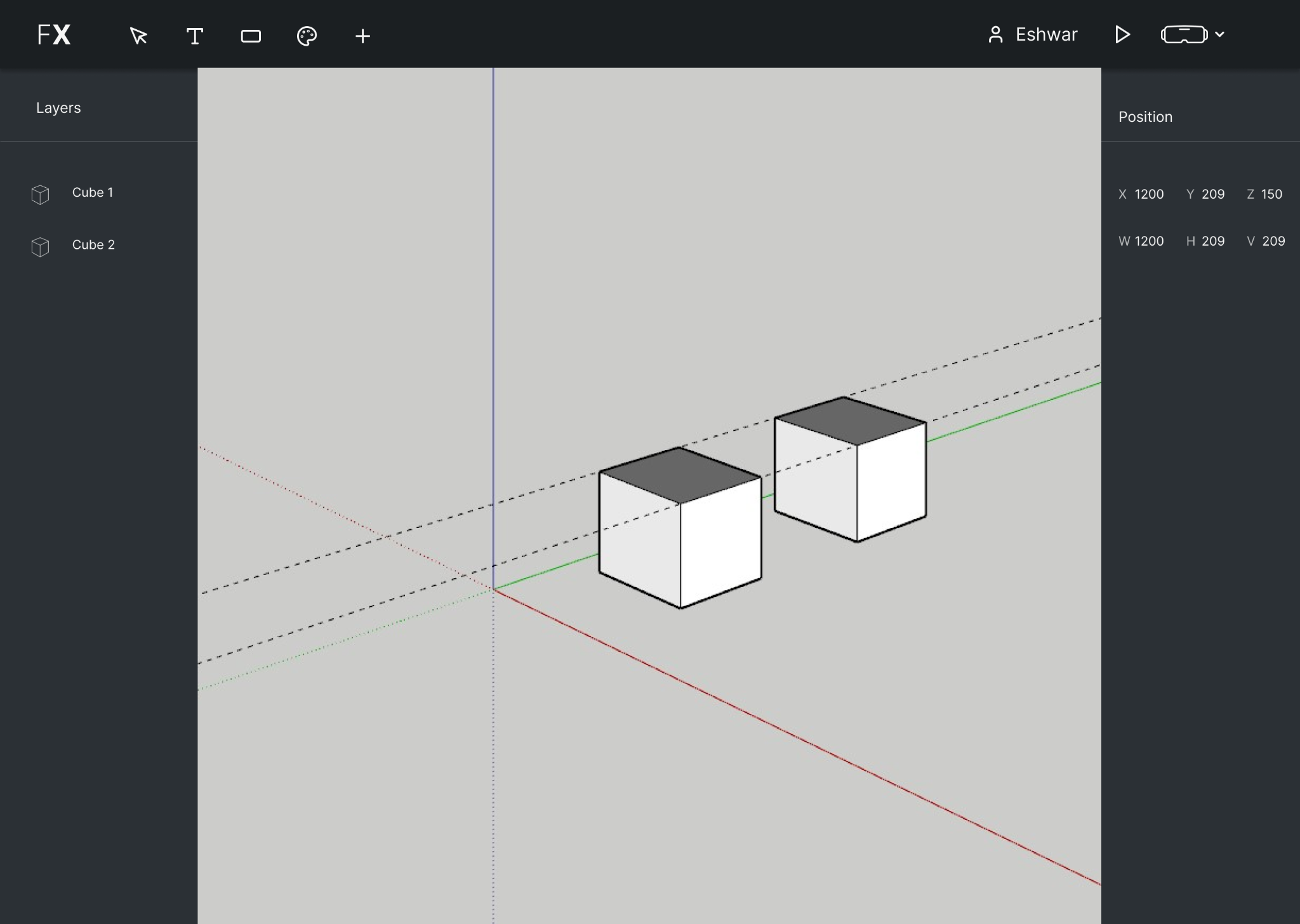
The original canvas concept shows layers, objects, and position controls.
Inspect originalTHE OPPORTUNITY BEHIND THE SCREENS
The handoff was part of the problem.
The original problem slide describes interfaces designed in Figma or Adobe XD being rebuilt in Unity. The product proposition was to make spatial creation and evaluation more connected.
Start with a familiar canvas.
Lower the barrier to defining the interface and its objects.
Make space visible.
Explore distance, scale, and headset-specific presentation.
Consider the existing workflow.
Plan a path into Unity instead of treating the editor as an isolated tool.
Trade-off
A stronger segment thesis still depended on category adoption.
The pivot accepted a different business and customer direction rather than preserve the original consumer thesis. Research, prototypes, funding, and patent activity could support development, but none guaranteed that the category was ready to adopt the product. That distinction became central later. I do not infer a quantified market-size result, enterprise sales pipeline, or adoption rate from the positive research signals.
Influence & execution
Align a small team and six faculty perspectives.
The work required alignment among approximately six faculty advisors with differing views. Product artifacts—including opportunities, MVP definition, PRDs, concepts, prototypes, and roadmap priorities—made the direction tangible. These supported product definition and development in the research setting. The exact disagreements and the decision changed by a particular artifact still need documentation, so the case does not invent a dramatic consensus moment.
Outcome
Grant and patent progress did not become durable adoption.
The work contributed to a provisional patent filing and an approximately $40,000 development grant. A provisional filing is not a granted patent. Despite positive research, funding, and filing signals, market/category adoption remained insufficient, and development was ultimately discontinued. The grant is a contributing outcome, not proof of PMF; discontinuation is part of the result rather than an inconvenient detail to omit.
Learning
Market timing is a product constraint.
A problem can be valid while the surrounding market is not ready to support the product. This initiative connected 0→1 discovery, business-model change, leadership, and the limits of positive early signals. The strongest next evidence would explain the adoption gap precisely: who was not ready, what blocked use, and how that shaped the decision to discontinue development.
THE REASONING BEHIND THE RESULT
What made the decision difficult?
Inspect ownership, evidence, alternatives, technical constraints, and the limits of the result.
CONTINUE THROUGH THE WORK