Estimated implementation cost after scope revisions
Context
The BRD described a broad product ambition.
I received a Business Requirements Document for an enterprise vendor-management product. Administrators needed to work across vendor performance, capacity, licensing, production planning, and operational information. The initial question was what the complete workflow could become. The first product concept represented that broader future state. It created a useful vision, but it also exposed a second question: how much of that vision belonged in the current-quarter build?
My ownership
I translated business requirements into product decisions.
I translated the BRD into a PRD and product definition, defined workflows and features, collaborated with engineering and architecture, rapidly prototyped the experience, and presented the broad vision. I then participated in scope optimization and reprioritized capabilities. This was a progression from describing the full product to deciding which capabilities justified their implementation cost now. Architecture and engineering estimates remained collaborative inputs.
Evidence
SAP changed the economics of apparently simple features.
SAP remained the system of record. Some valuable-looking capabilities implied expensive architecture changes, deeper integrations, or write-back behavior. Their cost could not be understood from an interface alone. Engineering and architecture discussions made that dependency visible. The supplied Capabilities wireframe explicitly labels assignments as read-only and sourced from SAP, with View actions rather than editing controls. The central evidence was the relationship between a user-facing capability and the underlying system change required to deliver it—not a preference for fewer screens.
Product judgment
Separate core value from expensive near-term complexity.
The decision was whether to force the full future-state vision into the immediate build or preserve the most useful workflows with a narrower implementation. I helped separate core / now from deferrable / later capabilities. Some information could remain view-only rather than requiring deeper system modifications. The aim was to preserve the product’s value while changing the commitment being made for the current quarter.
| Dimension | Full future-state vision | Revised near-term scope |
|---|---|---|
| Product ambition | Complete vendor workflow | Preserve essential workflows |
| System implications | Deeper integrations and write-back | View-only where appropriate |
| Sequencing | Broad capability now | Core / now; deferrable / later |
| Estimate index | 100 | ~66 · calculated from 34% reduction |
Decision summary reconstructed from Mani’s account. Original artifact not supplied.
TECHNICAL REALITY / READ-ONLY DOES NOT MEAN REMOVED
Keep the information.
Respect the system boundary.
The Capabilities wireframe makes one constraint explicit: assignments are sourced from SAP and read-only. View controls preserve access to the information without presenting an editing workflow. That distinction gives the product trade-off a concrete form.
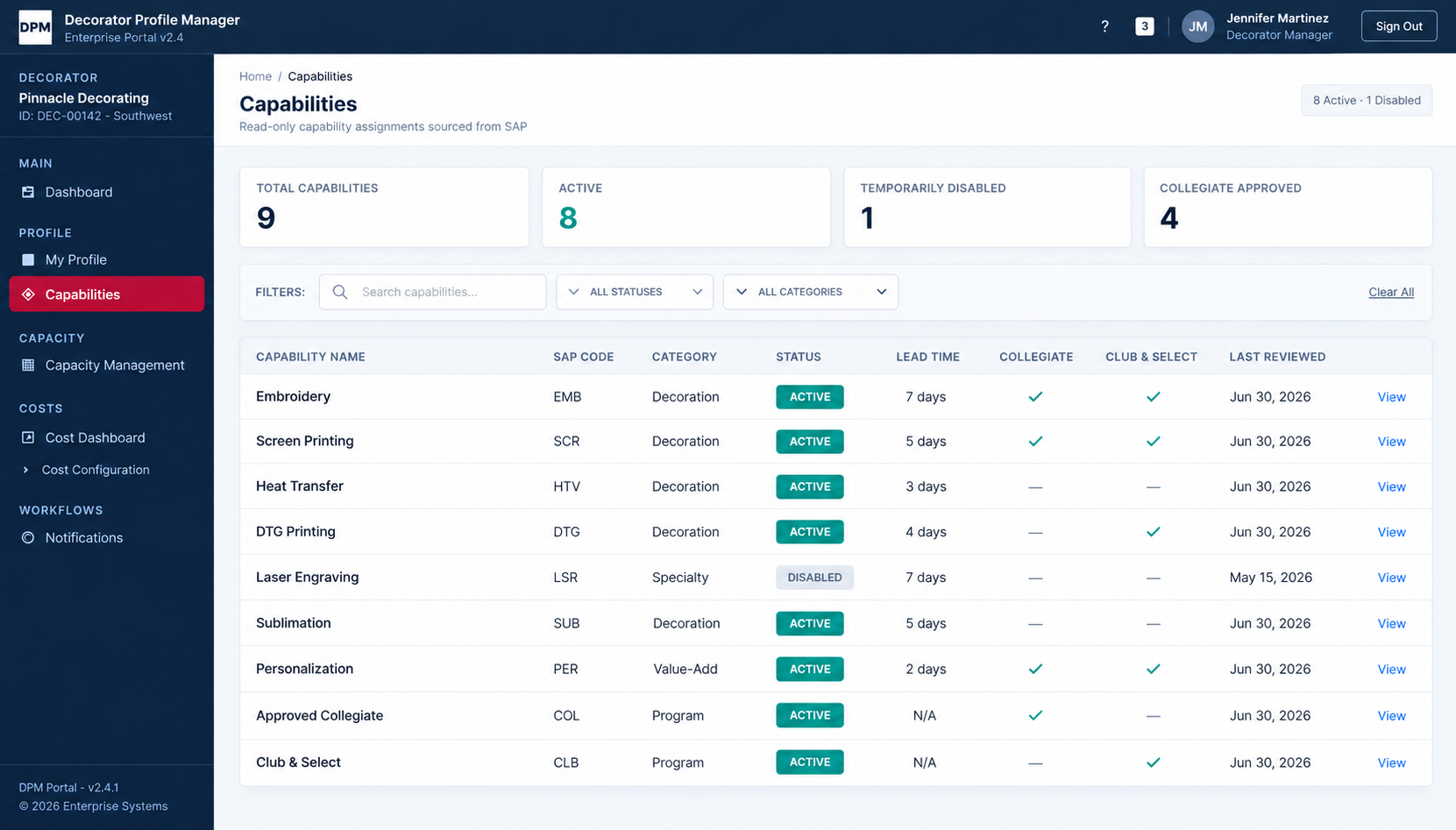
Presentation styling applied to the supplied wireframe. This variant retains its original Costs navigation; it is not presented as the final reduced scope. Sample capability counts are interface content.
Trade-off
Accept less immediate capability to protect feasibility.
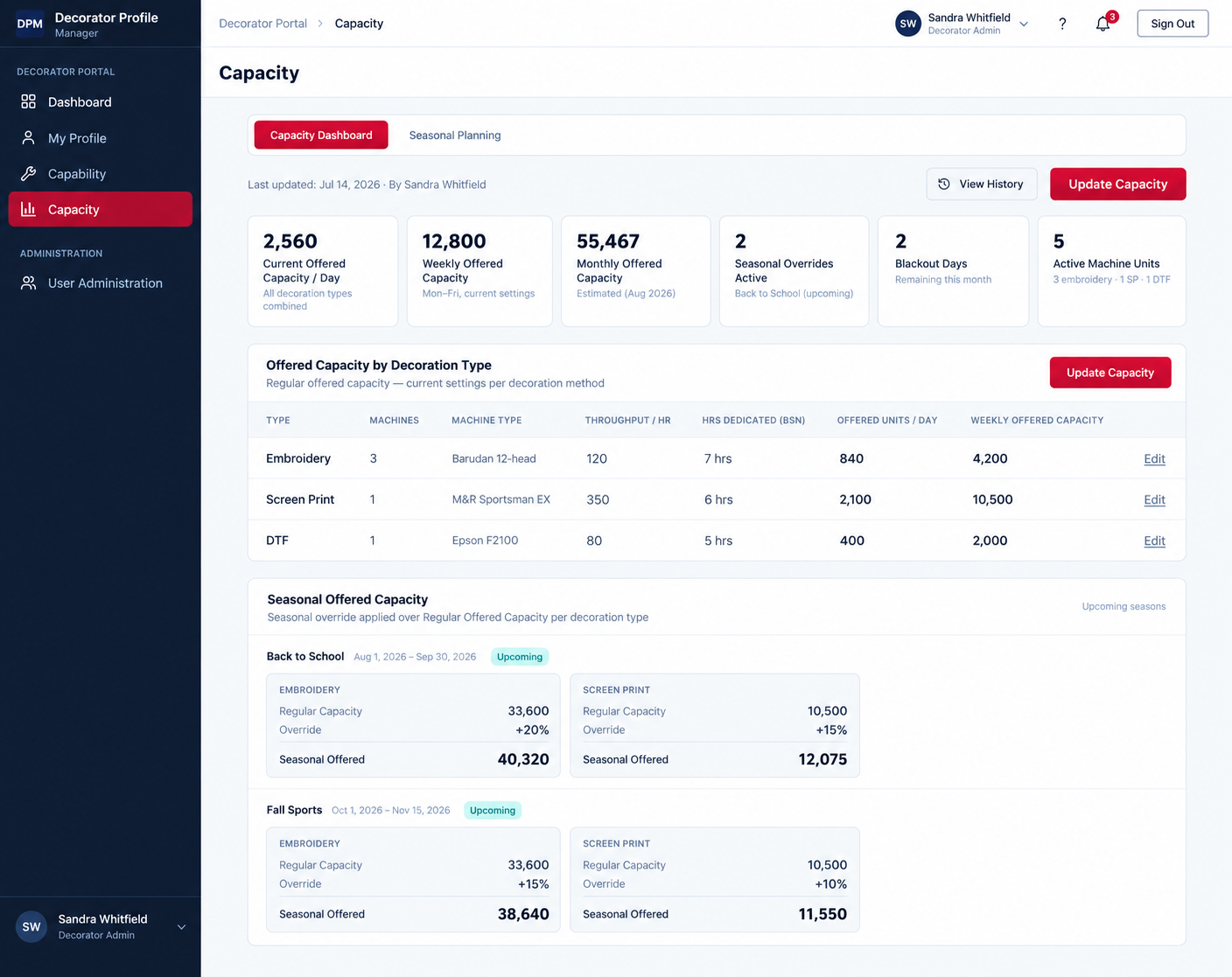
We chose a more feasible near-term scope at the expense of some future-state capability. The product vision still mattered; not every part of it needed to be implemented at once. Scope went through four revisions with architects, engineering, and business stakeholders. Each revision was an opportunity to distinguish essential workflows from costly or nonessential near-term work. The supplied versions show a narrower navigation and a reduction from five capacity tabs to two. The approved deferral list and each feature’s cost contribution still require the source scope documents.
Influence & execution
Use the prototype and estimates to change the scope conversation.
The broad prototype first made the future product tangible. Repeated discussions then connected that vision to integration effort and business priorities. I helped move the work through product definition, prototype reviews, and scope revisions. The contribution was not simply to reduce a number: it was to keep the core workflow legible while adjusting requirements. Detailed objections, approval owners, and the estimate methodology remain to be documented.
Outcome
Four revisions later, the implementation estimate was 34% lower.
The revised scope reduced estimated implementation cost by approximately 34% while preserving core workflows. This compares estimates between scope versions. It is not vendor-negotiation savings, realized production savings, or a claim about UI cost alone. The supplied evidence does not establish final production spend or post-launch operational performance. The result is a credible scoping and feasibility outcome at the planning stage.
Learning
A product vision and a delivery commitment serve different purposes.
The broad vision helped define the opportunity. Prioritization made the immediate commitment more credible. Technical fluency mattered because write-back and system-of-record constraints changed what a feature actually cost. The PM judgment was to keep user and business value in the conversation while accepting a smaller near-term capability set.
THE REASONING BEHIND THE RESULT
What made the decision difficult?
Inspect ownership, evidence, alternatives, technical constraints, and the limits of the result.
CONTINUE THROUGH THE WORK